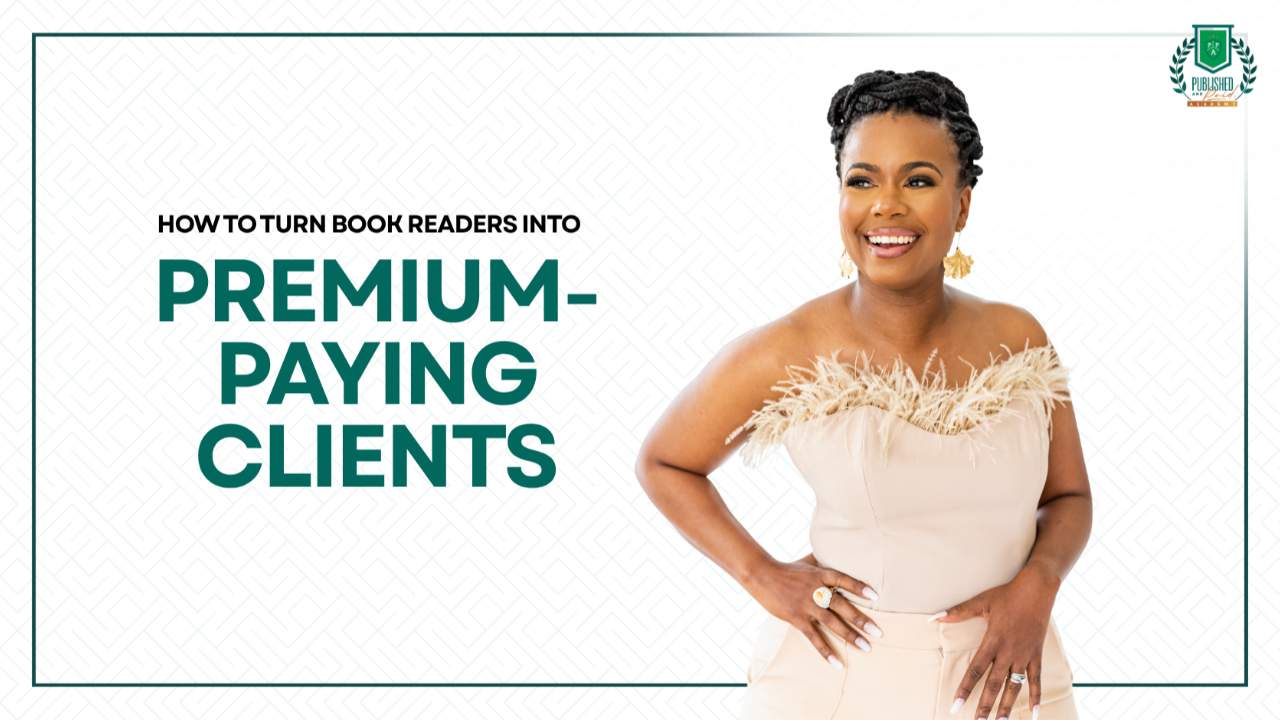
How to Turn Book Readers Into Premium-Paying Clients
One of the biggest misconceptions I see among authors is the belief that writing the book is enough.
They believe that once someone buys the book, reads it, and sees how much they know, that person is automatically going to want to hire them.
But that is not how it works.
Over the past 10 years, I’ve worked with entrepreneurs and experts from all kinds of industries. I’m talking about six and seven-figure business owners, government contractors, attorneys, executives, therapists, consultants, nonprofit leaders, educators, coaches, and speakers.
Some of these people have decades of experience and an incredible track record of results, yet they still struggle to charge premium prices.
It is not because they are unqualified, but because they have not learned how to position their authority beyond the book.
If you want your book to create opportunities for speaking, coaching, consulting, events, and other premium offers, you need a strategy for what happens after someone reads it.
Start With a Book That Solves a Specific Problem
Not every book is designed to generate premium opportunities.
If you want to monetize beyond book sales, your book needs to position you as an authority on a specific subject and help your reader solve a specific problem. That distinction matters.
A journal with blank pages, a coloring book, or a book you wrote simply because you wanted to become an author will not automatically position you to sell a high-ticket offer.
You have to think about the business strategy behind the book.
What problem does your book help solve? What does your reader understand or know how to do differently after reading it? How does that transformation connect to the work you are qualified to help them do next?
Your book needs a job inside your business.
Stop Positioning Yourself as an Author Only
Yes, tell people you wrote the book. Be proud of it.
But do not make being an author your entire identity.
Being an author is a credential. It is not a business model.
Instead of only saying, “I’m the author of such and such,” communicate who you help, how you help them, the result you help them achieve, and why that result matters.
Your book gives you credibility, but your expertise, when positioned properly, helps you create demand. There is a difference.
Give Your Readers a Clear Next Step
This is where a lot of authors leave money on the table.
They have a book, but nothing comes after it. Someone purchases it, reads it, and the customer journey ends.
If you want your book to generate business, you have to intentionally decide where your reader should go next.
That journey might start with a free resource, lead to your book, then move into a paid workshop, group program, and eventually a premium coaching or consulting offer.
Your journey may look different, but there needs to be a journey, and you have to tell people what it is.
Do not simply say, “Visit my website,” and expect people to search around until they find the right offer.
Spell it out.
If you do not tell people what to do next, they may assume there is no next step.
Premium Buyers Buy Transformation
Another place authors and experts miss the mark is in how they communicate their value.
They focus on information.
But when we are talking about premium offers and high-ticket services, your clients are not simply paying for more information. They are paying for outcomes.
That means you have to be clear about the transformation attached to your book, coaching program, consulting offer, workshop, or speaking topic.
What result can you help someone achieve? What problem gets solved? What changes as a result of working with you?
Your audience needs to understand the payoff. Information may demonstrate what you know, but transformation communicates why someone should invest.

Leverage the Credentials You Already Have
If you have legitimate credentials, use them.
Your credentials may include a master’s degree, doctorate, professional certification, executive experience, 20 years in an industry, documented client results, or a business you successfully built from the ground up.
Whatever your real credentials are, leverage them.
And if you do not have traditional professional credentials, that does not mean you do not have authority. Your experience and track record can be part of your positioning too.
Do not hide what you have accomplished because you are worried about appearing arrogant. Your authority is not arrogance. Your authority is clarity.
People need to know that you know what you know. They need to understand your experience, expertise, methodology, and results.
Especially in a marketplace where it is increasingly easy for people to present themselves as something they are not, real expertise matters.
Develop a Signature Framework
Now think about how you actually help your clients get results.
There is probably a process you use repeatedly without even thinking about it.
You may ask similar questions, walk clients through a particular series of steps, or approach problems using a methodology you have developed through years of experience.
That is where your signature framework begins. Premium clients are not looking for random advice, they buy systems.
Your framework helps people understand that there is a method behind the results you create. It can also become the foundation for your book, speaking topics, coaching programs, workshops, and other offers.
But giving your framework a catchy name is not enough. You still have to communicate what it helps someone accomplish.
Frameworks create distinction, distinction creates demand, and demand supports premium pricing.
Build Trust Beyond Your Book
Your book can create awareness, but your relationship with a potential client should not end on the final page.
Think about all the other ways someone can experience your expertise.
Your podcast allows them to hear how you think and gives you room to go deeper than you could in a chapter.
Speaking lets people experience your expertise in real time, email marketing allows you to continue the conversation, workshops give people an opportunity to learn from you, and case studies allow you to demonstrate how your methodology produces results.
These are all additional touchpoints that build trust.
And when someone is considering making a premium investment, trust matters.
Being the Most Qualified Is Not Enough
I have met people with PhDs charging less than people with absolutely no professional credentials.
I have met experts with 20 years of experience charging less than people with two.
The market does not automatically reward the person who is the most qualified on paper. It rewards the person who clearly communicates value.
That is why simply writing a book is not enough.
Your book, credentials, and experience matter, but you still have to position them.
You have to build the customer journey, communicate the transformation, develop your framework, build trust, confidently price your expertise, and ask for the sale.
Your book can open the door.
Make sure you have a strategy for what happens when someone walks through it.
Listen to the full episode of the Published and Paid Podcast to hear more about how to position your expertise beyond your book, turn readers into premium-paying clients, and create bigger opportunities from your intellectual property.
Ready to Monetize Your Expertise Beyond the Book?
Inside the Monetize Your Book Challenge, I teach experts how to turn their current or future thought-leadership book into a profit-producing platform through authorship, speaking, high-ticket coaching, consulting, and events.
During five days of live training, you'll develop a clearer strategy for turning your expertise into premium offers, multiple income streams, and authority that positions you for bigger opportunities.
Grab your VIP ticket at www.JasmineWomack.com/monetize.
Your expertise was never meant to stay hidden.
Release your expertise. Write the book. Take the stage. Get published. Get paid.
Stay connected with news and updates!
Join our mailing list to receive the latest news and updates from our team.
Don't worry, your information will not be shared.
